
Section 1 Introduction – Understanding the T20 World Cup Schedule
The T20 World Cup Schedule is one of the most anticipated pieces of information for cricket fans across the globe. Every year, millions of viewers wait eagerly for the official match fixtures to see when their favorite teams will play, which stadiums will host the biggest clashes, and how the tournament will unfold. The excitement becomes even more intense because the T20 format is known for unpredictability, fast-paced action, and last-over thrillers that keep fans on the edge of their seats.

Organized by the ICC Men’s T20 World Cup, the tournament brings together top cricketing nations and emerging teams to compete for global glory. From power-packed batting to game-changing bowling spells, every match becomes a battle of skill, strategy, and nerves. That’s why having a clear understanding of the T20 World Cup Schedule is essential for fans who want to track their team’s journey, plan their viewing experience, and stay updated with match timings, venues, and fixtures.
In this blog, we’ll walk you through everything you need to know about the tournament schedule—from dates and venues to match breakdowns, team fixtures, and expert insights. Whether you are a beginner trying to understand how cricket schedules work or a regular viewer who wants detailed match information, this guide will simplify the entire structure in an easy and practical way.
What makes the T20 World Cup Schedule even more exciting this year is the diversity of venues, new rivalries, and a packed lineup of high-stakes matches. Fans can look forward to electrifying group-stage clashes, nail-biting Super 8 encounters, and unforgettable semi-finals leading to a grand finale.
Throughout this blog, you will also find:
- Complete match fixtures
- Team-wise schedule
- Venue & pitch conditions
- Key clashes you shouldn’t miss
- Latest updates & changes
- Beginner-friendly breakdown of how schedules work
By the end of this guide, you will have a full understanding of the tournament structure and how the T20 World Cup Schedule shapes the excitement, competitiveness, and momentum of the entire event.
Table of Contents
Section 2 – What Is the T20 World Cup Schedule & Why It Matters?
The T20 World Cup Schedule is the officially released timetable that includes the full list of matches, dates, timing, venues, and team-wise fixtures for the ICC Men’s T20 World Cup. It acts as the backbone of the tournament, guiding fans, broadcasters, teams, coaches, analysts, and even fantasy cricket players.
Understanding the schedule is important because the T20 format is extremely fast, strategic, and unpredictable. Every match can shift the tournament dynamics, and the schedule helps everyone follow the flow of competition smoothly.
✔ What Exactly Is the T20 World Cup Schedule?
In simple terms, the schedule includes:
- Match Dates – When each match will be played
- Match Timings – Local time + converted international time zones
- Venues – Stadiums hosting each match
- Team Fixtures – Who plays whom, in which group/stage
- Stage Details – Group Stage, Super 8, Semi-Finals, Final
- Rest Days – Important for team recovery and strategy
It’s a complete roadmap showing how the entire tournament unfolds from start to finish.
✔ Why Does the T20 World Cup Schedule Matter So Much?
The importance of the schedule goes beyond simple match timings. Here’s why:
1. Helps Fans Plan Their Viewing Experience
Fans from different countries want to know:
- When their team plays
- Whether the match is in day or night
- How to adjust for time zone differences
Without the schedule, following matches becomes chaotic.
2. Teams Strategize Based on the Schedule
Coaches & players analyze:
- Opponent order
- Short gaps vs long gaps
- Conditions of different venues
- Travel requirements
For example, if a team plays back-to-back matches in different cities, it affects performance, recovery, and strategy.
3. Broadcasters & Media Plan Content Around It
Channels, OTT platforms, commentators, sponsors—everyone depends on the official schedule to plan:
- Match promotions
- Preview shows
- Panel discussions
- Post-match analysis
The schedule drives the entire media ecosystem.
4. Fantasy Cricket Players Need It
Platforms like fantasy cricket rely on schedules so users can:
- Select players based on venue
- Check match timing
- Avoid late line-up issues
- Track double-headers
Accurate scheduling = better predictions and winning chances.
5. Stadium Visitors Use the Schedule for Ticket Bookings
Fans attending live matches need to know:
- Which stadium hosts their team
- How to plan travel
- Best dates to book tickets early
- Crowd expectations & high-demand matches
The earlier the schedule is released, the better the planning.
6. Creates Hype & Momentum for the Tournament
The schedule announcement is often a major event.
It boosts:
- Social media buzz
- Team rivalries
- Fan excitement
- Ticket sales
- Match-day predictions
It almost acts like the official countdown to the World Cup.
✔ What Makes the T20 Format So Dependent on Scheduling?
The T20 format is short—just 40 overs total—so tournaments pack many matches within a tight timeframe. That means:
- Multiple matches on the same day (double-headers)
- Back-to-back high-pressure games
- Crowd-packed weekends
- Strategic matchup spacing
This is why the schedule must be perfectly balanced to ensure fairness and entertainment.
✔ Real-Life Example: Why Schedule Matters
Imagine a scenario:
- Team A has two days of rest before facing a strong opponent.
- Team B plays back-to-back matches with travel in between.
Result?
- Team A is fresh and strategized.
- Team B is tired, making mistakes under pressure.
This is how scheduling directly affects performance and sometimes even tournament outcomes.
✔ Summary: Why You Must Understand the T20 World Cup Schedule
Knowing the schedule helps you:
- Track every match effortlessly
- Plan viewing times
- Follow your favorite team’s journey
- Understand tournament progression
- Stay updated with timing, venues & fixtures
It’s the foundation of the entire T20 World Cup experience.
Section 3 – Complete T20 World Cup Schedule Overview – Dates, Matches & Venues
The T20 World Cup Schedule is the most crucial component for fans who want to follow the tournament from start to finish. This section gives you a complete, structured, and easy-to-understand overview of how the tournament progresses across different stages. From the opening match to the grand finale, everything follows a well-organized structure that ensures fair play, excitement, and global engagement.
Even though official fixtures may change depending on the tournament year, the structure of the T20 World Cup Schedule generally follows a fixed format, which we will break down in detail so every cricket lover — whether beginner or intermediate — can understand it with clarity.
✔ Tournament Duration & Format Breakdown
The T20 World Cup typically runs for 4–5 weeks, with matches played almost every day. The schedule is divided into clear stages:
- Group Stage
- Super 8 or Super 12 Stage (depends on format for the year)
- Semi-Finals
- Final
Each stage has its own match sets, timings, and venue selections.
✔ Group Stage Overview
The tournament begins with multiple groups, generally divided as:
- Group A
- Group B
- Group C
- Group D
Each group usually has 4–5 teams, depending on the format selected by ICC.
Key Highlights of Group Stage Scheduling
- Each team plays against all other teams in its group.
- Matches are distributed across different venues to maintain fairness.
- The top teams from each group qualify for the next round.
- Most group matches are scheduled in double-header format on weekends for higher viewership.
Typical Number of Group Stage Matches
Around 24–32 matches, making this the longest stage in the entire T20 World Cup Schedule.
✔ Super 8 / Super 12 Stage (Mid-Tournament Phase)
Once the group stage completes, the qualified teams enter the next level:
- Super 8 (8 qualified teams, 2 groups)
or - Super 12 (12 teams, 2 groups)
This depends on the ICC’s tournament structure for that year.
Scheduling Details
- Teams are divided into new groups.
- Each team plays against the other teams in their group.
- Matches become more intense because all teams are top-performing sides.
This stage plays a massive role in shaping the semifinal lineup.
✔ Semi-Finals – Knockout Stage
The T20 World Cup Schedule always reserves prime-time slots for the knockout matches. Only the top two teams from each Super Group qualify.
Semi-Final Scheduling Essentials
- Played at two major stadiums
- Held on different days to maximize global viewership
- Includes reserve days in case of rain or technical interruption
Semi-finals are high-stakes matches, often deciding the fate of favorite teams.
✔ The Grand Finale – Championship Day
The final match is the most celebrated day in the entire T20 World Cup Schedule. It usually takes place on:
- A Sunday (for maximum global audience)
- At a high-capacity stadium
- Under floodlights (Day-Night format)
This is the day when cricket history is written, and one team becomes the world champion.
✔ Venue Distribution in the Schedule
The ICC ensures matches are spread fairly across multiple stadiums to provide equal playing opportunities.
Venues are selected based on:
- Capacity
- Pitch conditions
- Weather reliability
- Travel convenience
- Previous international match experience
Each stadium typically hosts 3–5 matches, including some high-voltage clashes.
✔ Match Timings Explained
Match timings in the schedule usually include:
- Afternoon matches: 1 PM – 3 PM local time
- Evening matches: 7 PM – 8 PM local time
The evening matches attract the most viewers globally, so high-profile games are placed here.
Time zones also matter, especially for fans watching from:
- India
- Pakistan
- Bangladesh
- Sri Lanka
- UK
- Australia
- UAE
The schedule includes both local and converted timings to avoid confusion.
✔ Rest Days & Travel Breaks
The T20 World Cup Schedule is designed to be intense, but ICC ensures:
- Players get adequate rest
- Travel time is manageable
- Key matches don’t occur on consecutive days
Rest days are usually added before:
- Semi-finals
- Final
- Long travel distances between venues
✔ Key Pattern Observed in T20 World Cup Schedule
Here is a general pattern noticed:
- Opening match: Host nation often plays
- Rivalry matches: India vs Pakistan, Australia vs England, etc. — placed on weekends
- High-stakes matches: Scheduled at prime time
- Lower-ranked teams: Balanced across weekdays
- Knockout matches: Weekend or prime weekday slots
This strategic planning maintains tournament excitement from start to finish.
✔ Summary
The T20 World Cup Schedule is designed to provide the perfect balance between competition, entertainment, fairness, and global audience convenience. Its structured flow — from group stage battles to the thrilling final — ensures that fans can enjoy nonstop cricketing action with clarity and excitement.
Section 4 – Team-by-Team Match Fixtures Breakdown
The T20 World Cup Schedule becomes far easier to understand when it is broken down team-by-team. Fans usually want to track the journey of their favorite nation across the tournament. This detailed breakdown helps you follow each team’s fixtures, their match sequence, timing patterns, and strategic advantages or challenges they may face based on scheduling.
In this section, we will explain how team-by-team fixtures are generally structured, why some teams get easier or tougher schedules, and what factors influence their match placements. This is a highly practical and beginner-friendly guide based on the standard ICC T20 World Cup format.
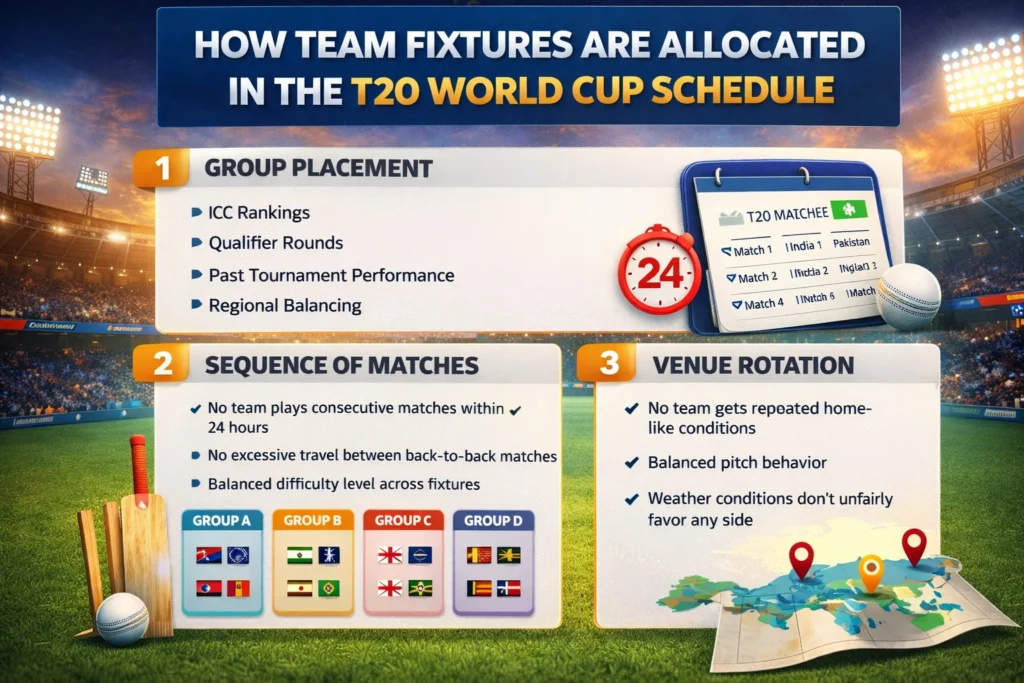
✔ How Team Fixtures Are Allocated in the T20 World Cup Schedule
The ICC follows specific rules and balancing criteria while creating fixtures for each team:
1. Group Placement
Teams are placed in groups based on:
- ICC rankings
- Qualifier rounds
- Past tournament performance
- Regional balancing
Each group must contain a mix of strong and developing cricketing nations.
2. Sequence of Matches
The sequence is designed to ensure fairness:
- No team plays consecutive matches within 24 hours
- No excessive travel between back-to-back matches
- Balanced difficulty level across fixtures
For example:
A top-tier team may not be given two powerhouse opponents back-to-back in the early stage.
3. Venue Rotation
Teams are rotated across venues so that:
- No team gets repeated home-like conditions
- Every team experiences balanced pitch behavior
- Weather conditions don’t unfairly favor any side
✔ Sample Team-by-Team Fixtures Explanation (General Format)
Below is a typical example of how fixtures look team-wise. (Note: This is a format-based explanation, not actual year-specific fixtures.)
⭐ India – Fixture Pattern Example
India’s matches usually attract the largest global audience. Therefore:
- Most matches are scheduled during prime time (evening slots)
- High-voltage games (like India vs Pakistan) are placed on weekends
- Venues are selected for large crowd capacity
Typical structure:
- Match 1 – vs Group Rival A
- Rest Day
- Match 2 – Big Rival Clash
- Travel Break
- Match 3 – Medium-ranked team
- Match 4 – Decider match for Super Stage qualification
India often gets well-distributed rest days to maximize performance and viewership.
⭐ Pakistan – Fixture Pattern Example
Pakistan’s schedule is designed for:
- High-watched rivalries (India, Australia, England)
- Balanced travel
- Slow-turning pitch venues for spin strength
Typical fixture order:
- Medium opponent
- High-rival game (India/Premium team)
- Lower-ranked team
- Qualification decider
Pakistan usually has one match in a spin-friendly venue.
⭐ Australia – Fixture Pattern Example
Australia often plays in:
- Fast and bouncy pitch venues
- Afternoon matches or early evenings
Their schedule tends to include:
- High-ranked opponent
- Lesser-known team
- Strong contender
- Final group match – must-win scenario
Australia’s fixtures are balanced between difficult and easier matches.
⭐ England – Fixture Pattern Example
England’s T20 style favors:
- Batting-friendly pitches
- High-scoring venues
Typical fixture flow:
- Opening match vs strategic opponent
- High-scoring venue match
- Rivalry-based match
- Final match before qualification
England’s matches often end up producing high totals.
⭐ South Africa – Fixture Pattern Example
Their schedule is usually set to:
- Test them early with big matches
- Give momentum with easier mid-stage matches
Pattern:
- Big team
- Lesser-ranked
- Competitive team
- Last match decisive
⭐ New Zealand – Fixture Pattern Example
New Zealand often gets:
- Balanced scheduling
- Varied pitch conditions
- Long travel rotations
Pattern:
- Strong opponent
- Medium team
- Lesser-known
- Super stage qualification match
Their matches often test adaptability.
⭐ Sri Lanka, Bangladesh, Afghanistan – Fixture Pattern Example
These teams usually face:
- Tough early rounds
- Mix of opponents
- Varied playing conditions
Their schedules help determine early tournament balance.
⭐ Associate Nations – Fixture Pattern Example
Teams like:
- Netherlands
- Ireland
- Namibia
- Scotland
- UAE
- Oman
- USA
Usually get:
- Balanced opportunities against strong and emerging teams
- Group-stage matches spread across 3–4 venues
- At least one weekend match for maximum audiences
✔ Why Team-by-Team Breakdown Helps Fans?
This format helps you understand:
1. The Difficulty Level of Each Team’s Journey
Some teams start with easy matches and build momentum.
Others face tough teams early.
2. Predicted Qualification Chances
By knowing who plays whom and when, you can analyze:
- Upset possibilities
- Pressure games
- Must-win matches
3. Understanding Match Strategies
For example:
- India playing a spin-heavy team on a turning pitch
- Australia playing England on a bouncy track
- Pakistan facing New Zealand under lights
These factors play a major role in match outcomes.
4. Viewership Planning
Fans can plan:
- Which games to watch
- Key rivalry matches
- High-adrenaline fixtures
✔ Practical Example of Fixture Influence
Imagine a group where:
- Team A plays its toughest match first
- Team B plays its easiest match first
The momentum difference:
- Team A may be under pressure from the beginning
- Team B gains confidence early
This is why understanding the T20 World Cup Schedule team-wise is so important.
✔ Summary
A team-by-team breakdown gives fans a clear understanding of how their nation progresses through the tournament. It explains the flow, difficulty level, rest days, venue conditions, and match timings — all crucial elements that shape a team’s World Cup journey.
Section 5 – How to Read & Understand the T20 World Cup Schedule (Beginner-Friendly Guide)
The T20 World Cup Schedule may look confusing at first—groups, timings, venues, stages, qualifiers, double-headers… it’s a lot to take in! But once you understand the structure behind it, the entire tournament becomes easier to follow, especially for beginners.
This detailed, example-based guide will help you read any T20 World Cup schedule like a pro.
✔ Why Understanding the Schedule is Important
Most fans jump straight into match lists, but understanding how the schedule works helps you:
- Track your team’s progression
- Know when crucial matches are happening
- Predict qualification scenarios
- Evaluate difficulty levels
- Understand tournament momentum
A structured schedule is not random – every match is placed strategically. Once you learn the pattern, everything starts making sense.
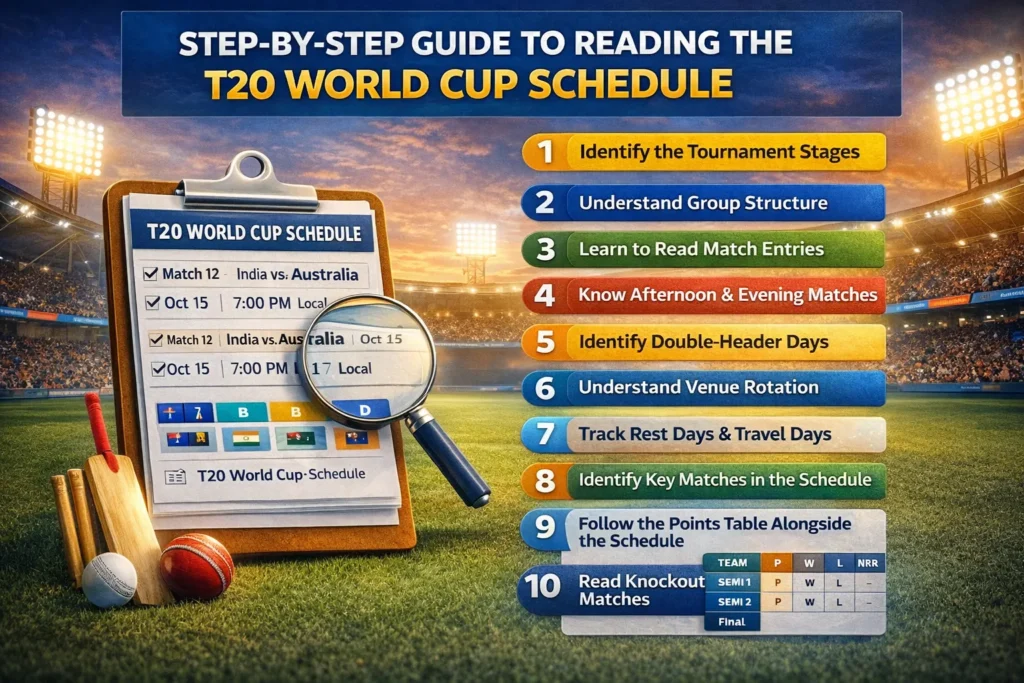
✔ Step-by-Step Guide to Reading the T20 World Cup Schedule
Step 1: Identify the Tournament Stages
Every T20 World Cup schedule is divided into four parts:
- Group Stage
- Super Stage (Super 8 or Super 12)
- Semi-Finals
- Final
Before reading the schedule, you must know which stage you’re looking at.
Each stage has its own purpose, pacing, and competitiveness.
Step 2: Understand Group Structure
Teams are divided into groups such as:
- Group A
- Group B
- Group C
- Group D
Each group usually has 4–5 teams.
When reading the schedule:
- Check which teams belong to your favorite team’s group.
- Check who they play first, second, and last.
- Understand that the top teams from each group qualify for the next round.
This gives you an overview of qualification pressure and difficulty.
Step 3: Learn to Read Match Entries in the Schedule
A typical match entry looks like this:
Match 12 – India vs Australia | Oct 15 | 7:00 PM Local | Stadium Name
Here’s how to decode it:
- Match Number: Helps track progression
- Teams: Who is playing
- Date: When the match is scheduled
- Time: Afternoon or evening
- Venue: Stadium & city
The time zone is important because matches may show local time but international fans watch from different regions.
Step 4: Know the Difference Between Afternoon & Evening Matches
The schedule uses two primary slots:
- Afternoon Match: 1:00 PM – 3:00 PM
- Evening Match: 7:00 PM – 8:00 PM
Evening matches often feature big teams because they get global viewership.
If you’re planning to watch matches live, understanding this helps you avoid missing key games.
Step 5: Identify Double-Header Days
A double-header means two back-to-back matches on the same day.
Format example:
- Match 14: South Africa vs Bangladesh (1:30 PM)
- Match 15: England vs Sri Lanka (7:00 PM)
Double-headers matter because:
- Weekends usually feature them
- High-profile games are placed in the evening slot
- These are important for viewers planning an entire day around cricket
Step 6: Understand Venue Rotation
Each team plays in multiple venues to maintain fairness.
When reading fixtures, note:
- Spinning pitch venues (Asian grounds, slow & turning)
- Fast/bouncy pitch venues (Australia, South Africa)
- Batting-friendly or high-altitude venues
This helps you understand match conditions and performance expectations.
Example:
If a team strong in pace bowling plays in a turning track, the advantage shifts.
Step 7: Track Rest Days & Travel Days
The schedule is carefully created so no team gets exhausted unfairly.
When analyzing a fixture list:
- See how many rest days your team gets
- Watch for back-to-back matches
- Notice long travel gaps between venues
More rest usually results in better performance.
Step 8: Identify Key Matches in the Schedule
Some matches are more important than others:
- Rivalry Matches
- Top-ranked teams meeting early
- Elimination matches
- Qualification deciders
These matches are usually placed on weekends or evening slots.
Understanding this helps you separate casual matches from must-watch games.
Step 9: Follow the Points Table Alongside the Schedule
The schedule tells you when matches happen.
The points table tells you what impact it has.
A match late in the group stage may suddenly become do-or-die.
When reading schedules, always connect the dots:
- Wins
- Net Run Rate (NRR)
- Remaining fixtures
- Opponent strength
This helps predict which team might qualify.
Step 10: Reading Knockout Matches
The knockout rounds (Semi-finals & Final) follow these rules:
- Top teams from Super Stage qualify
- Semi-final matchups depend on rankings
- Reserve days are included
- Timings are usually prime-time global slots
Knowing this helps fans understand the final pathway to glory.
✔ Beginner-Friendly Example of Reading a Full Schedule
Imagine a team’s group fixtures are:
- Match 1 – vs Strong Team
- Match 2 – vs Medium Team
- Match 3 – vs Lower-ranked Team
- Match 4 – Decider against competitive opponent
What this means:
- First match: Sets the tone
- Second match: Must maintain momentum
- Third match: Opportunity to strengthen NRR
- Fourth match: Likely qualification decider
This is how experts read schedules strategically.
✔ Why Understanding the Schedule Helps You Enjoy the Tournament More
Once you know how to read the schedule properly, you can:
- Plan match viewing
- Predict outcomes
- Track your favorite team
- Understand pressure situations
- Analyze performance scientifically
The T20 World Cup becomes more engaging and entertaining.
Section 6 – Key Matches, Rivalries & High-Voltage Clashes in the T20 World Cup
The T20 World Cup Schedule becomes truly exciting when you identify the matches that go beyond cricket—they carry emotion, history, rivalry, and global anticipation. These high-voltage clashes attract record-breaking viewership, massive stadium attendances, and intense media coverage. Fans wait for them more than the final itself!
In this section, we break down the biggest rivalries, the most awaited fixtures, and the reasons why certain matches dominate the headlines every tournament year.
✔ What Makes a Match “High-Voltage”?
A match becomes high-voltage when:
- The teams share a historic rivalry
- Past encounters created unforgettable moments
- The match has high stakes (qualification, elimination, prestige)
- Global fan bases tune in in massive numbers
- Star players face off
- The game happens in a prime-time slot
- The stadium atmosphere is electric
These matches are placed carefully within the T20 World Cup Schedule to maximize excitement and viewership.
🔥 1. India vs Pakistan – The Biggest Rivalry in World Cricket
No match in world cricket generates more hype than India vs Pakistan.
Why this clash is legendary:
- Historical rivalry spanning decades
- Huge global audiences (record-breaking every time)
- High-pressure atmosphere
- Rare bilateral series — they meet mostly in ICC events
- Dramatic past moments in T20 World Cup history
Impact on the Schedule
This match is almost always:
- Scheduled on a weekend
- Placed in the evening prime-time slot
- Hosted in a large-capacity stadium
It is often the most-watched fixture in the entire tournament.
🔥 2. Australia vs England – The Ashes in T20 Format
These two teams share a rivalry built on generations of cricket battles.
Why it’s intense:
- Oldest international rivalry
- Aggressive playing styles
- Fast-paced cricket
- History of controversies
- Crowd electricity
Schedule Pattern
Usually scheduled:
- Mid-tournament
- In a batting-friendly venue
- Often as a late-evening blockbuster
The match is known for fiery pace attacks and big-hitting displays.
🔥 3. India vs Australia – Clash of Titans
In ICC tournaments, India vs Australia has become one of the most exciting modern-day rivalries.
Why this rivalry is high-voltage:
- Finals and semi-finals history
- Strong competitive mindset on both sides
- Superstar players
- Youth vs experience battles
Schedule Placement
Often placed:
- During the Super Stage
- In high-capacity stadiums
- With millions watching worldwide
The match is known for intense pressure moments.
🔥 4. Pakistan vs Australia – High Temper, High Drama
This rivalry brings unpredictability and thrill.
Why it matters:
- Pakistan’s spin vs Australia’s pace
- Past World Cup thrillers
- Close finishes
- Skill-based matchups
Their matches are strategically placed to balance viewer demand and tournament flow.
🔥 5. England vs New Zealand – Underrated but Explosive
This rivalry became iconic after several dramatic ICC finals and knockout clashes.
Why it’s special:
- Both teams known for aggressive cricket
- Tactical depth
- Super over history
- High mutual respect
Matches are often placed during mid or late stages of the tournament.
🔥 6. Sri Lanka vs Bangladesh – A Battle of Asian Pride
While not as globally hyped, it is extremely intense within Asia.
Why fans love this clash:
- Regional pride
- Big crowds from both nations
- Close-knit performances
- Rising young talent
Usually placed early in the group stage, helping set tournament momentum.
🔥 7. South Africa vs New Zealand – “Chokers vs Comeback Kings”
This rivalry has created unforgettable heartbreaks and unexpected comebacks.
Why it’s exciting:
- High-pressure knockouts
- Climactic finishes
- Reputation battles
These matches are often critical for qualification scenarios.
🔥 8. Emerging Rivalries – New Age High-Voltage Matches
In recent years, new rivalries have emerged due to rising teams:
Examples:
- Afghanistan vs Pakistan
- Ireland vs Scotland
- Netherlands vs Sri Lanka
- USA vs Canada (growing excitement)
These matches bring fresh narratives and surprise upsets.
✔ Why High-Voltage Matches Are Carefully Placed in the Schedule
The T20 World Cup Schedule is designed to maximize excitement and momentum. So, these matches are placed with intention:
1. Weekend Prime-Time Slots
Maximum viewers across India, Pakistan, UK, Australia, and the Middle East.
2. Large Stadiums
To accommodate 40,000–80,000 fans for atmosphere and revenue.
3. Mid-to-Late Tournament Stages
To maintain excitement as teams approach qualification rounds.
4. Balanced Pressure
Avoiding burnout for teams having back-to-back big matches.
5. Boosting Engagement
These blockbuster games keep global interest alive.
✔ Why Fans Should Track Key Rivalries in the Schedule
Understanding rivalry placement in the T20 World Cup Schedule helps you:
- Know the most exciting matches to watch
- Plan viewing times for must-watch fixtures
- Predict tournament momentum shifts
- Understand pressure points for each team
- Follow emotional and historic matchups
These matches often decide:
- Group standings
- Qualification chances
- Net Run Rate impact
- Tournament favorites
✔ Real-Life Example: How One Match Changes the Tournament
Imagine an India vs Pakistan group match.
If Pakistan wins:
- India is under pressure for the next game
- Pakistan gains massive momentum
- Points table shifts early
- Media hype increases
- Fans from both nations react emotionally
This single match can change the energy of the entire tournament.
✔ Summary
High-voltage clashes are the heart of the T20 World Cup. They bring drama, entertainment, rivalry, and unforgettable moments. When you understand where these matches lie in the T20 World Cup Schedule, you can fully enjoy the journey of all teams and the thrill of every stage.
Section 7 – Venue Guide: Stadium Details, Pitch Reports & Match Conditions
The T20 World Cup Schedule does not make sense unless you understand where the matches are being played. Venues play a massive role in determining match outcomes because each stadium has its own unique pitch behavior, ground dimensions, weather conditions, and crowd impact. A strong team can still struggle if the conditions don’t suit their style of play.

This section provides a complete, beginner-friendly, yet expert-level breakdown of how World Cup venues influence the tournament. Even though exact stadiums may vary from year to year, the concepts explained here apply universally to every T20 World Cup.
✔ Why Venues Matter in the T20 World Cup Schedule
Every venue impacts the game differently:
- Some pitches favor explosive batting
- Some help fast bowlers with bounce
- Some assist spinners due to dryness
- Ground size changes scoring rates
- Weather influences swing, pace, and dew factor
This is why the T20 World Cup Schedule carefully rotates teams across different conditions to ensure fairness.
✔ Key Elements of a Stadium That Influence Matches
1. Pitch Type
The most important factor. There are three main types:
• Batting-Friendly (Flat Pitches)
- High-scoring matches
- Ball comes nicely onto the bat
- 180–200 totals are common
- Suits aggressive teams
- Great for power-hitters
These pitches usually produce crowd-pleasing T20 games.
• Pace-Friendly (Bounce & Carry)
- Helps fast bowlers
- Early swing movement
- Hard surfaces
- Edges fly to slip region
Teams with strong pace attacks dominate here.
• Spin-Friendly (Dry or Turning Tracks)
- Slow and tricky to bat
- Helps spinners grip and turn
- Scores stay around 140–160
- Requires smart batting
Asian teams often excel on these surfaces.
2. Ground Dimensions
Smaller grounds =
- More sixes
- More boundaries
- More 200+ scores
Larger grounds =
- More running between wickets
- More wicket-taking opportunities
- Spinners benefit from bigger outfields
Teams with strong fielding units love big grounds.
3. Weather Conditions
Weather plays a major role in scheduling:
• Hot & Dry Conditions
- Helps spinners
- Drying pitch increases turn
- Ball gets softer quickly
• Overcast Conditions
- Helps swing bowlers
- Fast bowlers dominate early overs
• Dew Factor (Night Matches)
Dew is one of the biggest match-influencers in T20:
- Makes the ball wet
- Hard to grip for bowlers
- Spin becomes ineffective
- Batting becomes easier in the second innings
This is why some teams prefer chasing in dew-heavy nights.
4. Crowd Impact
A passionate crowd boosts performance:
- Home-like support increases motivation
- Pressure on opposition batters
- Noise affects communication
Teams with large fanbases (India, Pakistan, Bangladesh) gain a psychological advantage in packed stadiums.
✔ Common Types of Venues Used in T20 World Cups
Below is a general breakdown of venue categories and their typical behavior.
⭐ Batting Paradise Venues
Examples include many modern stadiums globally.
Characteristics:
- True bounce
- Lightning-fast outfields
- Batter-friendly pitch
- 200+ scores likely
Teams that benefit:
- India
- England
- Australia
- West Indies
Type of matches:
- High-scoring thrillers
- Last-over finishes
⭐ Spin-Friendly Venues
Often found in Asia, UAE, and some slow surfaces worldwide.
Characteristics:
- Dry pitch
- Slow turn
- Spinners dominate
- Middle overs become crucial
Teams that benefit:
- Sri Lanka
- Bangladesh
- Afghanistan
- India
Type of matches:
- Tactical low-scoring games
⭐ Pace & Bounce Venues
Seen in Australia, South Africa, and some bouncy international stadiums.
Characteristics:
- Steep bounce
- Swing in the first few overs
- Outfields on the slower side
Teams that benefit:
- Australia
- South Africa
- New Zealand
Type of matches:
- Swing-dominated powerplays
- Fast scoring if batters settle
⭐ Balanced Venues
Some stadiums offer a mix of batting and bowling assistance.
Characteristics:
- Fair to both departments
- Toss less important
- Momentum changes frequently
These grounds produce the most unpredictable, exciting matches.
✔ How the Schedule Uses Venue Characteristics Strategically
The T20 World Cup Schedule uses venue diversity to create balance:
1. Big Matches in Big Stadiums
High-rivalry games like India vs Pakistan are placed in large venues for:
- Massive crowds
- Global visibility
- Electric atmosphere
2. Spinners or Pacers Based on Opponent Strength
A team strong against pace may face spin-friendly conditions to keep balance.
3. Weekend Matches in Popular Venues
To increase:
- Viewership
- Ticket sales
- Social media buzz
4. Travel-Friendly Clustering
Matches are grouped regionally to avoid:
- Player fatigue
- Long-distance travel
5. Weather-Safe Scheduling
Rain-prone venues get earlier time slots while knockout matches include:
- Reserve days
- D/N start for clarity
✔ How Fans Should Use Venue Knowledge
Understanding venue conditions helps you:
1. Predict Match Outcomes
For example:
Spin-friendly pitch + strong spin team = advantage.
2. Analyze Toss Decisions
Captains often choose to chase when dew is expected.
3. Expect High or Low Scores
Big grounds = lower scores
Small grounds = firework matches
4. Enjoy Tactical Depth
You will appreciate strategic decisions like:
- Bowling first
- Using spinners early
- Choosing power hitters or anchor players
✔ Example: How a Venue Decides the Game
Imagine a match between:
- A team strong in fast bowling
- A team strong in spin
If the venue has bounce, the pace team gains a huge advantage.
If the venue is dry and slow, the spin team gains the upper hand.
This is exactly why venues shape the outcome of many World Cup matches.
✔ Summary
Stadiums, pitches, weather, ground size, and crowd atmosphere together shape the T20 World Cup Schedule and match outcomes. Understanding these factors gives fans deeper insights into strategy, performance, and the reasons behind surprising or dominant victories.
Section 8 – Latest Updates, Changes & Important Announcements for the T20 World Cup Schedule
The T20 World Cup Schedule is not always fixed from the start. As the tournament approaches, various updates, modifications, and important announcements are released by organizers, broadcasters, and cricket boards. These changes can influence match timings, venues, team fixtures, weather plans, and even tournament rules.
This section explains—in a clear, reader-friendly, and professional way—how such updates happen, why they happen, and how they affect fans and teams. Even though every tournament year has its own specific updates, the process and logic behind schedule changes remain the same.
✔ Why Updates Are Common in the T20 World Cup Schedule
The T20 World Cup is a global event, so several factors influence the scheduling:
- Weather conditions
- Logistics and travel planning
- Stadium availability
- Broadcast timings
- Security measures
- Team rankings
- Government approvals
- Unexpected situations (storms, pitch conditions, delays)
Because of this, updates are a natural part of the World Cup preparation process.
✔ Types of Changes That Usually Happen in the Schedule
1. Match Timing Adjustments
This is the most common update.
Reasons may include:
- Prime-time adjustments for Indian or Australian audiences
- Weather forecasts (rain-prone evenings)
- Avoiding overlap with another major sporting event
- Broadcasting strategy
Example:
A match originally scheduled at 3:00 PM may get shifted to 7:00 PM for better global reach.
2. Venue Changes
A venue may be changed due to:
- Unexpected pitch damage
- Heavy rain forecasts
- Stadium maintenance issues
- Political or security concerns
- Crowd management requirements
Venue updates are rare but can significantly impact match strategy.
3. Reserve Day Announcements
Knockout matches such as:
- Semi-Finals
- Final
Almost always get reserve days.
Sometimes, group matches may receive reserve day updates if rain forecasts are extremely high.
Reserve day announcements help prevent washouts in crucial matches.
4. Weather-Related Alerts
Weather plays a major role in cricket.
Organizers may release updates about:
- Expected rain delays
- High dew conditions
- Storm alerts
- Early start or delayed start possibilities
Fans and teams follow these updates closely because weather can change a match result.
5. Team Qualification Changes
As the tournament progresses:
- Teams entering Super 8 / Super 12
- Teams eliminated early
- Updated points table
- Net Run Rate implications
These updates influence future match importance.
Example:
A late-stage group match may shift from “normal fixture” to “must-win elimination game.”
6. Injury & Squad Announcements (Linked to Schedule Importance)
Teams release updates on:
- Player replacements
- Injury recoveries
- Captaincy changes
- Key players returning
These updates matter more when the schedule approaches a high-stakes match.
7. Broadcasting and Streaming Updates
Organizers often announce:
- New camera angles
- Multi-language commentary panels
- Special match-day programming
- Updated broadcast timings
These updates enhance the viewing experience and are tied to the match schedule.
✔ How Fans Should Track T20 World Cup Schedule Updates
Understanding updates helps fans avoid missing key matches. Here’s what to follow:
1. Official Announcements
Updates from the governing body, tournament website, or official platforms carry highest accuracy.
2. Broadcaster Notifications
TV channels and OTT platforms update match timings and pre-show schedules frequently.
3. Weather Forecasts
Weather apps help fans predict rain-affected matches.
4. Social Media Alerts
Most updates trend instantly across:
- Cricket boards
- Players
- Journalists
- Sports news outlets
5. Points Table Analysis
Knowing the team standings helps fans interpret updates better.
✔ How Updates Affect Teams Strategically
Schedule changes may influence:
1. Team Planning
A postponed match may give:
- Extra rest
- More net sessions
- Better recovery time
A preponed match may create scheduling pressure.
2. Venue-Dependent Strategies
If the venue changes:
- Spin-friendly to pace-friendly turf
- Bigger boundary to smaller boundary
- Dry pitch to green pitch
Teams must adjust their strategy quickly.
3. Toss Decisions
Weather conditions influence the decision to bat or bowl.
For example:
- Dew-heavy nights → teams prefer chasing
- Rain-forecast days → DLS method comes into play
4. Player Selection
Updates affect player choices:
- If a pitch is turning, teams may play multiple spinners
- If rain is forecast, they may choose swing bowlers
- If match time moves to night, dew-resistant bowlers are selected
✔ Real-Life Example of Schedule Update Impact
Imagine a high-voltage match that was supposed to be played on a dry afternoon pitch.
But due to heatwave risks, the match is shifted to evening.
As a result:
- Dew becomes a major factor
- Batting becomes easier in second innings
- Toss becomes crucial
- Spinners may struggle
- Fast bowlers may dominate early overs
This one update can completely change match outcomes.
✔ Why Fans Must Stay Updated Throughout the Tournament
Because schedule changes decide:
- Whether a match starts on time
- How teams strategize
- Which matches become must-watch events
- Weather disruptions
- Impact on tournament momentum
You can enjoy the tournament more when you are updated, aware, and fully informed about the flow of the T20 World Cup Schedule.
Section 9 – Frequently Asked Questions (FAQs)
The T20 World Cup Schedule brings excitement, but it also raises many common questions among fans who want clarity about match timings, venue rules, formats, and viewing options. This detailed FAQ section is designed to help both beginners and experienced cricket followers understand every important aspect in a simple, practical, and easy-to-read manner.
✔ FAQ 1: What is the T20 World Cup Schedule?
The T20 World Cup Schedule is the complete timetable that lists all matches, dates, timings, venues, and team fixtures for the tournament. It tells you:
- When matches will be played
- Which teams will face each other
- Which stadiums will host matches
- What time each game starts
- How the tournament progresses across stages
Understanding the schedule helps you follow the tournament smoothly from start to finish.
✔ FAQ 2: Who decides the T20 World Cup Schedule?
The schedule is officially prepared and released by the organizers of the
ICC Men’s T20 World Cup.
They consider multiple factors such as:
- Venue availability
- Weather conditions
- Global viewership timings
- Team logistics & travel
- Fairness in match distribution
This ensures a balanced and fair tournament.
✔ FAQ 3: Do match timings vary for different countries?
Yes.
The schedule mentions local time, but fans in other countries must convert it to their time zone.
For example:
- A match scheduled at 7:00 PM local time may be 4:30 PM in one country and 9:00 PM in another.
This is why broadcasters and sports apps also show converted timings for convenience.
✔ FAQ 4: Can the T20 World Cup Schedule change after it is announced?
Yes, changes can happen due to:
- Weather forecasts
- Security arrangements
- Stadium conditions
- Broadcast requirements
- Unforeseen emergencies
Such updates may include:
- Timing changes
- Venue changes
- Delay announcements
- Reserve-day activation
Fans should always follow official updates to stay informed.
✔ FAQ 5: What does “Double-Header” mean in the schedule?
A double-header means two matches are scheduled on the same day:
- One in the afternoon
- One in the evening
These days are usually packed with action and attract maximum viewership.
✔ FAQ 6: What is the difference between Group Stage, Super Stage, and Knockouts?
Group Stage
All teams are divided into groups and play round-robin matches.
The top teams qualify for the next stage.
Super 8 / Super 12 Stage
Qualified teams are re-grouped and compete again to determine semi-finalists.
Knockout Stage
- Semi-Finals
- Final
These matches determine the champion.
A single loss in the knockout phase ends the team’s campaign.
✔ FAQ 7: How do weather conditions affect the schedule?
Weather may cause:
- Match delays
- Reduced overs (DLS method)
- Rescheduled timings
- Abandoned matches
Night matches may also have dew, which heavily influences toss decisions.
✔ FAQ 8: How many matches does a team play in the T20 World Cup?
It depends on the format of that year.
Typically:
- Group Stage: 3–4 matches
- Super Stage: 3–4 matches
- Semi-Final: 1 match
- Final: 1 match
Teams reaching the final usually play 7–8 matches in total.
✔ FAQ 9: Is the T20 World Cup always hosted in a single country?
Not always.
Some editions are hosted:
- Entirely by one country
- Co-hosted by multiple nations
- Across regional clusters
Venue distribution depends on:
- Infrastructure
- Stadium capacity
- Geographic planning
✔ FAQ 10: How do rest days work in the schedule?
Rest days are added:
- Before crucial matches
- Before semi-finals
- Before the final
- When teams have long travel between venues
These breaks ensure players recover and prepare for high-pressure games.
✔ FAQ 11: Why are some matches played during the day and others at night?
Day matches help:
- Avoid dew
- Balance schedule volume
Night matches are placed to:
- Maximize global viewership
- Host high-voltage games
- Utilize floodlights for atmosphere
Rivalry matches and big clashes are usually scheduled at night.
✔ FAQ 12: How is the ranking or qualification scenario affected by a single match?
One match can influence:
- Points
- Net Run Rate (NRR)
- Team momentum
- Elimination risks
- Super Stage qualification
Especially in a short format like T20, every result is crucial.
✔ FAQ 13: How can fans stay updated with the latest schedule changes?
You can follow:
- Official tournament website
- Sports news channels
- Verified cricket apps
- Team social media profiles
- Broadcaster notifications
Changes are usually announced instantly on digital platforms.
✔ FAQ 14: Does the toss timing appear in the schedule?
The toss typically happens 30 minutes before match start time.
It is not part of the schedule but is crucial due to:
- Pitch reading
- Dew factor
- Weather
- Team strategy
✔ FAQ 15: Are reserve days available for all matches?
No.
Only:
- Semi-Finals
- Final
Usually get reserve days.
Group matches rarely have them unless weather conditions are extremely risky.
Section 10 – Conclusion + Strong Call to Action (CTA)
The T20 World Cup Schedule is much more than a simple list of matches — it is the roadmap of the world’s most thrilling cricket tournament. Understanding the schedule helps fans follow their favorite teams with clarity, plan their viewing experience, analyze match conditions, track qualification scenarios, and enjoy every stage of the World Cup with deeper insights.
Best Alternative Online Exchanges & Platforms to Try in 2026
| Keyword (Clickable Link) | Category | Search Intent |
|---|---|---|
| mylaser247 | Betting Platform | Informational / Navigational |
| swamiji99 | Online Betting | Commercial / Navigational |
| reddyonlinebook | Cricket Exchange | Navigational |
| playwin4 | Betting ID Service | Commercial / Informational |
| sky99exch | Cricket Exchange | Informational / Navigational |
Across this detailed 10-section guide, you’ve learned:
- How the schedule is structured from group stage to final
- Why fixtures matter strategically for teams
- How venues, pitch types, and weather conditions influence results
- Which high-voltage rivalry matches dominate global excitement
- How updates and last-minute changes affect the flow of the tournament
- How to read and decode the entire T20 World Cup Schedule like a pro
This knowledge allows you to experience the T20 World Cup with more confidence, more excitement, and a far better understanding of how each match impacts the road to the trophy.
The T20 format is fast, unpredictable, and adrenaline-packed — and the schedule is the key that unlocks the full thrill of the tournament. Whether you’re supporting your nation, enjoying the rivalries, or following the tournament for analysis and entertainment, staying updated with the schedule elevates your cricketing experience to a whole new level.
⭐ Final Thoughts
The T20 World Cup is not just a sporting event — it’s a global festival of passion, rivalry, drama, and unforgettable moments. And the schedule is your map to that journey. With every match offering new twists and emotions, this guide ensures you never miss a moment, never misunderstand a fixture, and always stay ahead of the excitement.
🔥 Strong Call to Action (CTA)
If you want the latest T20 World Cup Schedule updates, match fixtures, team stats, predictions, expert insights, and real-time alerts, keep visiting T20 World Cup — your trusted destination for everything cricket.
👉 Stay tuned, stay updated, and enjoy the most exciting cricket tournament on the planet!
👉 Bookmark the website right now so you never miss a single update or match announcement.